103. Shivkumar Sharma, Brijbushan Kabra and Hariprasad Chaurasia - Call Of The Valley (1967) Track Listing1. Ahir Bhairav/Nat Bhairav2. Rag Piloo3. Bhoop4. Rag Des5. Rag PahadiReviewSo we are in 1967, for the last couple of years there has been a marked obsession for all things indian in pop albums. This starts with the Beatles but the Byrds and even the more conservative Kinks got on the bandwagon. It is therefore only natural that attentions turned to the origins of these obsessions. Call of the Valley is really a different album from most of those which have been reviewed here.I have always been a big fan of Indian classical music, from Ravi Shankar's collaborations with Phillip Glass and Yehudi Menuhin to traditional Qawwali. In fact I wrote my undergraduate dissertation on Indian Sufi Music, mainly Qawwali. So I have developed a taste for this. But even if you haven't this is a great album to start. It is quite accessible and beautifully performed. There will be other albums of this type of music coming up here and unlike some of the choices on Brazilian music which I find quite innapropriate, the Indian selection is actually quite good. This album has an amazing energy tempered by a quite plaintive sound, while the rythmic tabla drums give it a sweltering energy, the santoor and flute bring it back down to a dream-like quality. It is not hard to imagine the same hippies getting high on Jefferson Airplane and then switching to this. It really has that kind of universal quality to it, it is very easy to relate to it although it is performed in a quite alien form. But no more alien than what people were experimenting with in the West in the 60's. Stream it from Napster or buy it from Amazon UK
or
US .
.
Track HighlightsIt is quite pointless to highlight 4 out of 5 tracks... and it is consistently good, so just listen to it.Final Grade8/10TriviaFrom Wikipedia: The santoor is a trapezoid-shaped hammered dulcimer often made of walnut, with seventy strings. The special-shaped mallets (mezrab) are lightweight and are held between the index and middle fingers. A typical santoor has two sets of bridges, providing a range of three octaves.The santoor is a hammered dulcimer, derived from the Persian santur (which is believed to be the first instrument of its type), and related to similar instruments in Iraq, Pakistan, Turkey, and other parts of Central Asia.The Indian santoor is more rectangular and can have more strings than the original Persian counterpart, which generally has 72 strings. The santoor as used in Indian classical musician is played with a pair of curved mallets made of walnut wood and the resultant melodies are similar to the music of the harp, harpsichord or piano. The sound chamber is also made of walnut wood and the bridges are made of local wood and painted dark like ebony. The strings are made of steel from Germany and England.Notable santoor players of the twentieth century include and Pandit Shivkumar Sharma, Pandit Bhajan Sopori, and Kiranpal Singh.The younger generation of santoor players include Rahul Sharma and Abhay Rustum Sopori, Saurav Chatterjee, and many other prominent names like Kakan Ghosal, Versha Aggarwal, Roshan Ali, and Sandip Chatterjee.
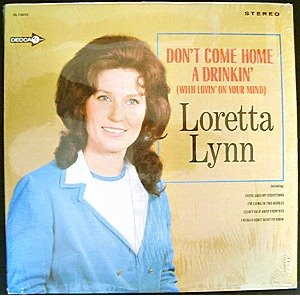
102. Loretta Lynn - Don't Come Home a Drinkin' (With Lovin' on Your Mind) (1967)
Track Listing1 Don't Come Home a Drinkin' (With Lovin' on Your Mind)2 I Really Don't Want to Know3 Tommorow Never Comes4 There Goes My Everything5 The Shoe Goes on the Other Foot Tonight6 Saint to Sinner7 The Devil Gets His Dues8 I Can't Keep Away from You9 I'm Living in Two Worlds10 Get What 'Cha Got and Go11 Making Plans12 I Got CaughtReviewAnother country album, and this one must be one of the best reviewed here up until now. Again like Haggard this is an album which really shines on the lyrics rather than the good but rather formulaic music. Loretta Lynn gives us a smattering of grassroots feminism which is not pretentious or overblown, but truthful and heartfelt. Loretta Lynn has a great voice and cheerily recounts tales of betrayal, revenge and women paying man back in the same coin. And it's just great. This is an album which demands repeated listenings and particular attention to the lyrics. If you don't pay attention to what Loretta is saying, it is very possible that his will just pass through you as an unremarkable country album.Unfortunately this is an impossible to get album. I have it on vinyl and I think that's the only way you can get it. Amazon lists unavailable Audio Cassetes but there is no CD reissue in Europe or the States. This is actually quite sad, as other crappier but more conservative country musicians reviewed here earlier have several editions of their albums available, but maybe that says more about the audience of country than the quality of the musicians. Cash, Haggard, Nelson and some others are of course exceptions but as much due to having found a following outside the Country Music scene as anything. Loretta herself has an audience but this, her best album, is almost lost.Track Highlights
1. Don't Come Home a Drinkin' (With Lovin' on Your Mind)2. Get What 'Cha Got and Go3. The Shoe Goes on the Other Foot Tonight4. Saint to SinnerFinal Grade8/10TriviaFrom Wikipedia:In her heyday, Lynn was no stranger to controversy. She had more banned songs than any other artist in the history of country music, including "Rated X" (about the double standards divorced women face), "Wings Upon Your Horns" (about the loss of teenage virginity), and most famously, "The Pill" (about a wife and mother becoming liberated via birth control).
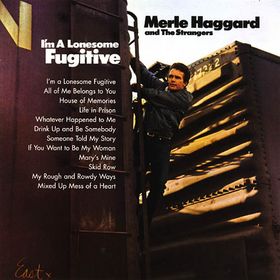
99. Merle Haggard - I'm A Lonesome Fugitive Track Listing1. I'm A Lonesome Fugitive2. All Of Me Belongs To You3. House Of Memories4. Life In A Prison5. Whatever Happened To Me6. Drink Up And Be Somebody7. Someone Told My Story8. If You Want To Be My Woman9. Mary's Mine10. Skid Row11. My Rough And Rowdy Ways12. Mixed Up Mess Of A HeartReviewA country album finally. We haven't had many of these and this one is actualy a worthy one. Not really that impressive musically, it sounds a bit like most other country albums but lyrically it really deserves its presence here. Haggard goes back to the earlier tradition of people like the Louvin' Brothers with hard hitting family unfriendly lyrics.And in lyrical terms this is a pretty impressive and unexpected album, Haggard is a great and a disturbed writer. He heard Johnny Cash in San Quentin in 1958, but unlike Cash he was actually doing time there. This album is very much touched by his prison experience and his criminal past.To me this is what makes a country album good, a certain rawness and sincerity mixed with pain and murderous feelings. However the album isn't that impressive musically. While Haggard certainly has a great voice which is perfect for his themes, the musical accompaniment is a bit run of the mill. So it really isn't the best Country album that you'll ever hear, but it is certainly an interesting one and worth a listen. You can stream it from Napster or buy it from Amazon UK or US.Track Highlights1. Life In Prison2. I'm A Lonesome Fugitive3. Drink Up And Be Somebody4. If You Want To Be My WomanFinal Grade6/10TriviaFrom Wikipedia:Haggard's parents moved from Oklahoma to California during the Great Depression; at that time, much of the population of Bakersfield was made up of economic refugees from Oklahoma and surrounding states. Haggard's father died when Merle was 9, and Merle began to rebel against his mother. Authorities put him in a juvenile detention center. Haggard's older brother gave him a guitar when Merle was 12, and he taught himself to play. In 1951, Haggard ran away to Texas with a friend but returned that same year and was arrested for truancy and petty larceny. He ran away from the next juvenile detention center to which he was sent and went to Modesto, California. He worked odd jobs - legal and not - and made his performing debut at a bar. Once he was found again, he was sent to the Preston School of Industry, a high-security installation. Shortly after he was released, 15 months later, Haggard was sent back after beating a local boy during a burglary attempt.After his second release, Haggard saw Lefty Frizzell in concert with his friend Bob Teague and sang a couple of songs for him. Lefty was so impressed, he allowed Haggard to sing at the concert. The audience loved Haggard, and he began working on a full-time music career. After earning a local reputation, Haggard's money problems caught up with him, and he was arrested for a robbery in 1957. He was sent to prison in San Quentin for 15 years. Even in prison, Haggard was wild. He planned an escape but never followed through, and he ran a gambling and brewing racket from his cell. Merle attended three of Johnny Cash's concerts at San Quentin. Cash inspired Haggard to straighten up and pursue his singing. Several years later, at another Cash concert, Haggard came up to Johnny and told him "I certainly enjoyed your show at San Quentin." Cash said "Merle, I don't remember you bein' in that show." Merle Haggard said, "Johnny, I wasn't in that show, I was in the audience." While put in solitary confinement on death row, Haggard encountered author and death row inmate Caryl Chessman. Haggard had the opportunity to escape with a fellow inmate nicknamed "Rabbit". Haggard passed on the chance to escape. The escape was successful. The man who escaped later shot a policeman and was returned to San Quentin and put to death. Chessman's predicament along with Rabbit's inspired Haggard to turn his life around, and he soon earned his high school equivalency diploma, kept a steady job in the prison's textile plant and played in the prison's band. He was released in 1960 and in March 1972 was pardoned by then California governor Ronald Reagan. Once released, Haggard said it took about four months to get used to being out of the penitentiary and that, at times, he actually wanted to go back in. He said it was the loneliest feeling he'd ever had.